
By Sutowo Wong, Managing Director, Applied AI & Data

How can a growing volume of genomic data become a resource that researchers and clinicians can use?
That question ran through Sutowo Wong’s presentation at the PRECISE–Temus signing event on 1 October 2026. The two signed a Memorandum of Understanding to establish a Joint Innovation Centre, bringing together PRECISE’s genomic science expertise and Temus’ technology and engineering capabilities.
For Sutowo Wong, Managing Director, Applied AI & Data at Temus, the starting point was how the teams worked together. Temus engineers collaborated closely with PRECISE’s scientists and AWS to solve challenges as they arose. That work reduced processing costs from about $30 to $0.50 per genome and processing time from a week to three hours.
As cohorts grow, those savings become substantial. He further looked beyond processing performance to discuss three connected shifts needed to make genomic data useful at scale.
1. A growing cohort needs a resource that grows with it
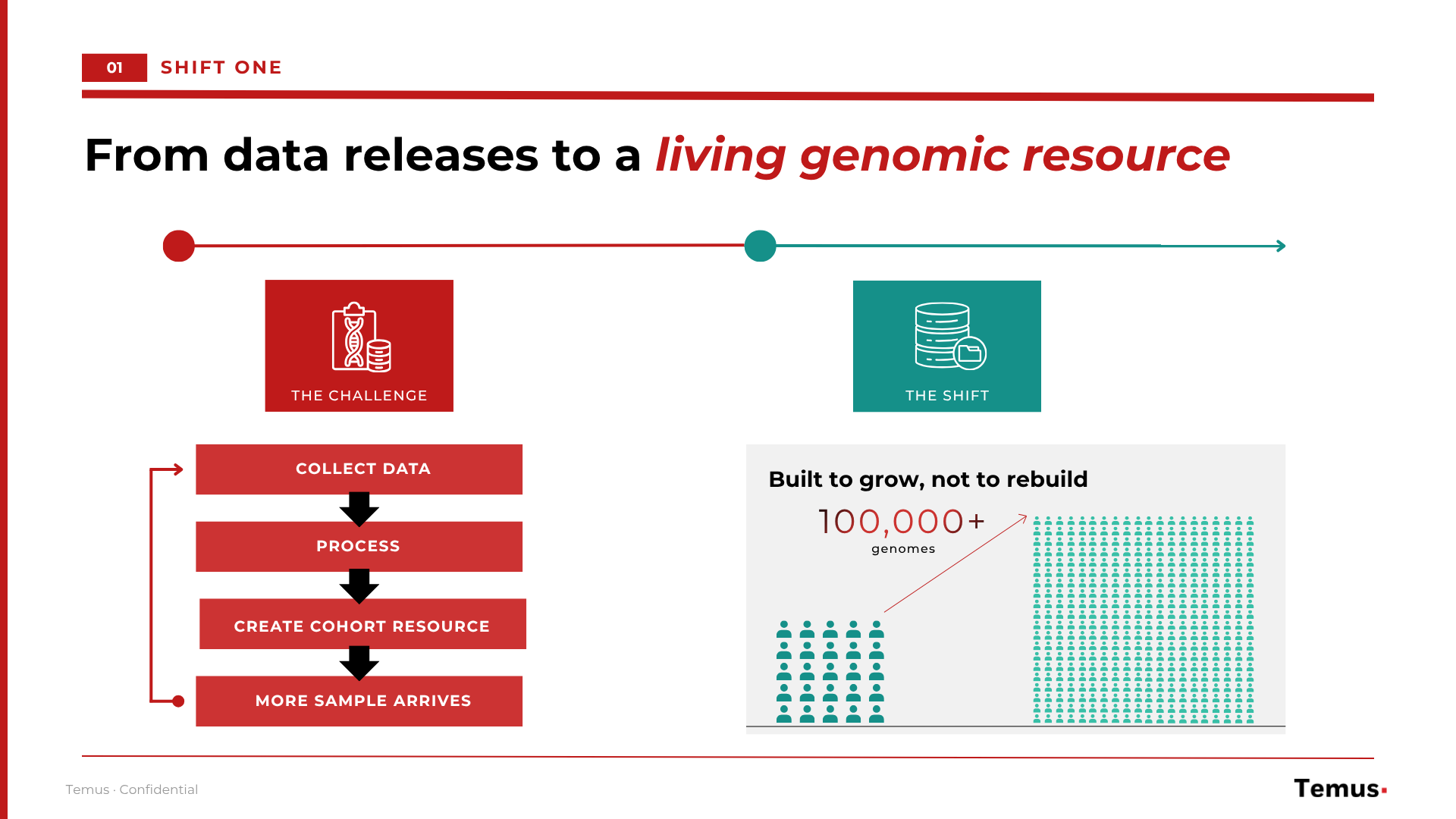
A typical genomic programme collects data, processes it, and creates a cohort resource. When new samples arrive, the cohort may need to be processed again—a cycle that becomes increasingly expensive and computationally demanding.
A living genomic resource changes that cycle. New samples can be incorporated incrementally, allowing the resource to expand without reprocessing the entire cohort each time.
In the PRECISE collaboration, Hail VDS supports more efficient storage and incremental additions. Combining samples in stages also enables processing to scale from smaller batches towards cohorts of 100,000 genomes.
The significance extends beyond faster processing. Each addition builds on work already completed, creating a more sustainable foundation for a growing programme.
That continuity addresses how the resource expands. Its usefulness also depends on whether researchers and clinicians can work consistently with the data it contains.
2. Harmonising data once makes it useful many times

Genomic data comes from different sequencing providers, hospitals and healthcare institutions. Formats and quality can vary, creating work before the data is ready for analysis.
Repeating that preparation for every research question limits how widely and efficiently the resource can be used. A consistent pipeline that brings data together and harmonises it once allows the same foundation to support multiple uses over time.
This is essential to making genomic data ready for AI. Models continue to advance, but their usefulness depends on dependable underlying data. Harmonisation, consistent quality, traceable processing histories, appropriate governance and secure computing environments all contribute to that foundation.
The opportunity is cumulative: preparation undertaken for one dataset can support further research without requiring each team to start again.
Yet a resource that supports research is only part of the journey. Applying its insights in healthcare requires connections between environments that operate differently.
3. Genomic insights need to fit the way care is delivered

Research and clinical care use different identifiers, systems, governance processes and workflows. Connecting them requires governed pathways through which findings can move into clinical use.
It also requires people who can interpret those findings. Genetic counsellors, for example, help patients and clinicians understand genomic information and its implications.
The everyday experience of healthcare professionals matters too. Switching between applications and logging in repeatedly introduces friction that can hinder adoption. Insights need to be accessible within clinical workflows, at the point where decisions are made.
Bringing the three shifts together
Scaling precision medicine therefore requires technology, clinical capability and workforce capacity to develop together.
The Joint Innovation Centre brings these needs into a shared programme spanning genomic data engineering, clinical integration, cloud infrastructure, talent development and innovation.
By bringing scientists, engineers and healthcare professionals together, the Centre can help turn a growing genomic resource into a lasting foundation for research and care. As these capabilities develop, so does the opportunity to bring genomic insights into more clinical decisions – and make precision medicine part of everyday healthcare.


